
Washington County Court Records After Arrest
Court records after a jail arrest in Washington County follow a custody-to-case path. The arrest or warrant service leads to booking at the Washington County Detention Center. The jail roster may show booking charges, bond, and sometimes court-date information. The 4th Judicial District Prosecuting Attorney then reviews law-enforcement submissions and decides whether to file state charges. Once a complaint, information, indictment, or other filing opens a case, the court record becomes the main source for filed charges and case events.
The distinction matters. The jail roster answers whether a person is held in the Washington County jail and what the booking row shows. Search ARCourts answers what case has been filed in court and what has happened there. For custody and booking fields, use Washington County jail inmate records. For booking-photo questions, use the Washington County jail mugshots page.
Find Court Records After Jail Arrest
The Arkansas Judiciary's Search ARCourts case portal is the main online court case search. The Judiciary describes Search ARCourts as the public system for case information, parties, judges, filings, charges and dispositions, future events, judgments, and some document links. Some information is withheld from internet access under Administrative Order 19, so a missing online result does not always mean no case exists.
- Search the jail roster first and note the name, intake date, charge description, bond, warrant number, or court date if shown.
- Open Search ARCourts and search by defendant name. Narrow by Washington County and criminal case type when results are broad.
- Search by case number if a citation, warrant, attorney, court notice, or roster detail provides one.
- Compare booking charges with formal court charges. The prosecutor may amend, reduce, add, or decline charges.
- Review court events for first appearance, arraignment, hearings, plea, trial date, disposition, or sentencing.
- Call the court where the case is filed if the online portal does not answer the question.
The manifest image for the Arkansas case search portal shows the public entry point used for court records after a Washington County arrest.
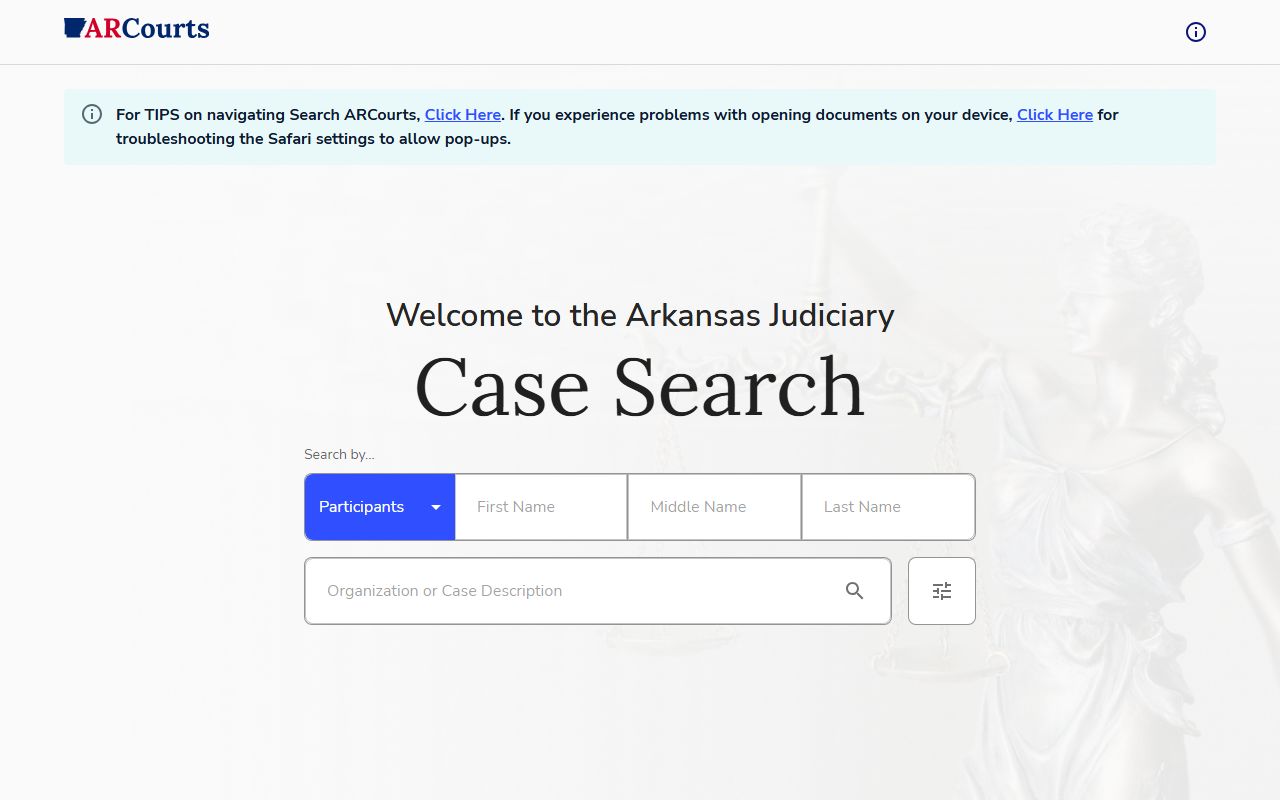
That portal is a case lookup, not a custody roster, so it should be paired with the sheriff's jail data when custody status still matters.
Washington County Court Search Fields
Search ARCourts is a different kind of search than the jail roster. A name search can find public case records when a case is indexed, while a case-number search is more precise if that number is known. Court and case-type filters help separate criminal cases from civil, domestic, probate, traffic, district, or circuit matters.
| Field Label | Type | Required | Notes |
|---|---|---|---|
| Person name | Text search | One search basis required | Use the defendant name from the jail roster, warrant entry, citation, or court notice. |
| Case number | Text search | Alternative search basis | Best when a notice, attorney, or court document provides the number. |
| Court / county / type | Filters | No | Narrows broad results to Washington County and criminal case records where available. |
| Case status | Filter | No | Useful to separate open, closed, pending, or disposed cases when the portal exposes the filter. |
| Documents | Links when available | No | Some public records include filing links, but documents are not promised for every case. |
Prosecutor Role After Arrest
The 4th Judicial District Prosecuting Attorney's Office handles prosecution of state crimes in Washington and Madison counties. The official county page identifies Brandon Carter as Prosecuting Attorney and lists the office at 280 N College Ave, Ste 301, Fayetteville, AR 72701, phone (479) 444-1570, with Monday-Friday, 8:00 a.m.-4:30 p.m. hours. The office reports responsibility for about 3,000 new felony cases each year from local law-enforcement agencies, about 2,000 juvenile cases, several thousand private-citizen complaints, and misdemeanors outside city corporate limits.
That workload explains why a booking charge can differ from a filed court charge. Police or deputies may book a person under an arrest or warrant description. The prosecutor then decides what to file, whether to amend, whether to add counts, or whether the proof supports a different charge. City misdemeanor, traffic, district court, juvenile, and circuit felony routing can vary, so the court where the case is filed controls the record.
Charging Documents After Arrest
A formal court record after a Washington County jail arrest usually begins with a charging document or court filing. The exact document depends on the offense, court, and procedural posture. The common terms are easy to mix up, but each marks a move from booking information to court-filed accusation.
| Document | Who Files or Issues It | What It Does |
|---|---|---|
| Complaint | Officer, prosecutor, or court process depending on case type | Starts or supports a criminal case with alleged facts or charges. |
| Information | Prosecutor | Formal prosecutor-filed charge document commonly used for many Arkansas felony cases. |
| Indictment | Grand jury | Formal accusation returned through grand jury process in cases where that route is used. |
Charge Status in Court Records
Charge status terms show where a case stands. A pending charge is still unresolved. An amended or reduced charge means the filed accusation changed. Dismissal and nolle prosequi end or stop prosecution of a count, but the public record may still show the earlier arrest and case history unless sealed or restricted by law.
| Status | What It Means |
|---|---|
| Pending | The charge has been filed and has not reached final disposition. |
| Amended | The prosecutor or court record changed the charge from an earlier version. |
| Reduced | The charge was replaced with a lower offense or lesser count. |
| Dismissed | The charge ended by court order or prosecution action. |
| Nolle prosequi | The prosecutor formally declined to proceed on that charge. |
| Conviction | A guilty plea, verdict, or finding, not the same as an arrest. |
Bond After Washington County Arrest
Bond information can appear in more than one place. The Washington County roster has a Bond column with dollar amounts or N/A. The warrant page also displays bond amounts for warrant entries. The detention FAQ tells users to check the website for charges, bond amounts, and court dates or call Detention at (479) 444-5830. A roster N/A should not be read as release eligibility or no case. It may reflect holds, commitments, immigration, parole or probation matters, court orders, or missing dollar-bond display.
| Bond or Release Type | Local Meaning |
|---|---|
| Cash bond | Money paid directly if the court allows cash bond; confirm payment rules before travel. |
| Surety bond | Bond posted through a licensed bail bond company; the FAQ points users to the Arkansas Bail Bond Licensing Board. |
| Personal recognizance | Release based on a promise to appear, often with court conditions. |
| No displayed dollar bond | N/A or hold status can require court or agency action before release. |
| Immigration bond | Separate from criminal bond; the FAQ gives immigration at (479) 444-9897 for eligibility questions. |
Warrants and Court Records After Arrest
The official Washington County warrant search can explain why a jail arrest occurred. The warrant page inspected on May 28, 2026 showed a last-updated timestamp of 8:25 PM and warned that recent status changes may not be reflected. It says warrant information must be verified through the official records system before apprehension or attempted arrest, and only law-enforcement officers can arrest a person on an outstanding warrant.
A bench warrant may come from a missed court date. A warrant booking can produce a jail record, a warrant record, and a court case record. Compare the warrant number, charge, bond, and warrant date with Search ARCourts to see whether the court record reflects the original case, a failure-to-appear event, a probation matter, or a new booking.
Charges vs Convictions
An arrest and a charge are accusations or custody events. A conviction is a court outcome. Washington County court records after a jail arrest can show both, but they should not be treated as the same fact. This matters for employment, housing, licensing, media use, and any situation where a case status must be stated precisely.
| Charge | Conviction | |
|---|---|---|
| Stage | Filed accusation after arrest or review | Final finding, plea, or verdict |
| Proof | Based on probable cause or charging decision | Requires plea or proof beyond a reasonable doubt |
| Record Meaning | Shows what was alleged | Shows an adjudicated outcome |
Sealed Court Records After Arrest
Arkansas law uses sealing procedures for eligible arrest and case records. Ark. Code section 16-90-1409 allows a person to petition to seal an arrest record in certain circumstances, including when charges have not been filed within one year. Arkansas DPS and ACIC provide criminal-history and sealing forms and state that ACIC has 30 days to complete an Order to Seal after receiving it.
| Sealed | Expunged | |
|---|---|---|
| Public View | Hidden from ordinary public access when the order applies. | Often used casually, but Arkansas users should follow the state's sealing process and order language. |
| Agency Action | Provide the order to the record custodian if a public entry remains. | Follow the court and ACIC process tied to the official order. |
| Online Limits | May remove or restrict official public display. | Does not automatically erase third-party copies from the internet. |
Restricted Washington County Court Records
Some court records after an arrest will not appear online. The Arkansas Judiciary says some information is not considered public under Administrative Order 19 and will not be available on the Internet. Juvenile matters, sealed records, confidential filings, protected addresses, medical information, active investigations, and court-restricted documents can be limited. For questions about Search ARCourts, the Judiciary lists Administrative Office of the Courts phone support, but questions about a specific case should go to the court where that case is filed.
Important: Court records, jail records, prosecutor records, and criminal-history reports have different custodians and different access rules.